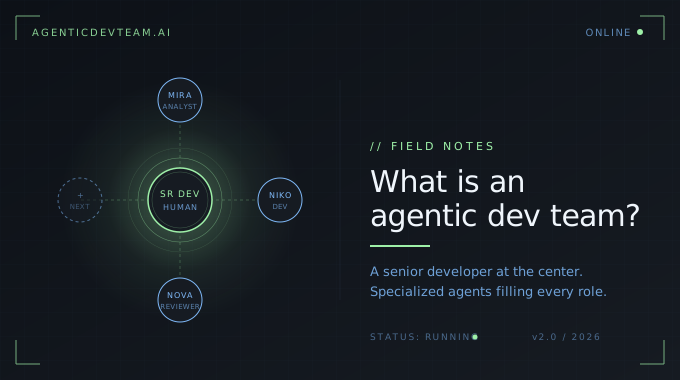
A senior developer at the center. Specialized agents filling every role.
The buzzword is everywhere. Here's what it actually means — and why it changes what's possible for your startup.
It feels like just a few months ago, "agentic AI" was a phrase only researchers used. Now it's in every pitch deck, every VC blog post, every LinkedIn hot take. And yet most founders still can't tell you what it means in practice — especially when it comes to building software.
So let's be concrete.
When AI coding tools first arrived, the mental model was simple: you're the driver, AI is the GPS. You type a function, it suggests the next line. You write a comment, it fills in the code below. Fast? Yes. Transformative? Not really — it was still fundamentally a one-human, one-keyboard operation.
You were still doing all the thinking. The AI was just a very good typist.
That model has a ceiling. It scales your speed without scaling your capacity. You can type faster, but you're still the only one typing.
"Agentic" doesn't mean AI that thinks harder. It means AI that keeps going.
A traditional AI tool waits for your next prompt. An agent runs a loop: observe, reason, act, observe again. It reads files, runs commands, calls APIs, checks the output, and decides what to do next — without stopping to ask you at every step.
That loop is the fundamental difference. It transforms AI from a suggestion engine into an autonomous collaborator.
The second key property: agents can be composed. You don't have one agent doing everything. You design a system where different agents handle different roles, hand off work between them, and run in parallel. That's what makes the throughput jump.
Think of a small engineering team. There's someone writing the code, someone reviewing it, someone running tests, and someone managing integration. In a traditional setup, those people serialize their work — writer finishes, reviewer picks it up, tester follows.
In an agentic setup, those roles can overlap and parallelize:
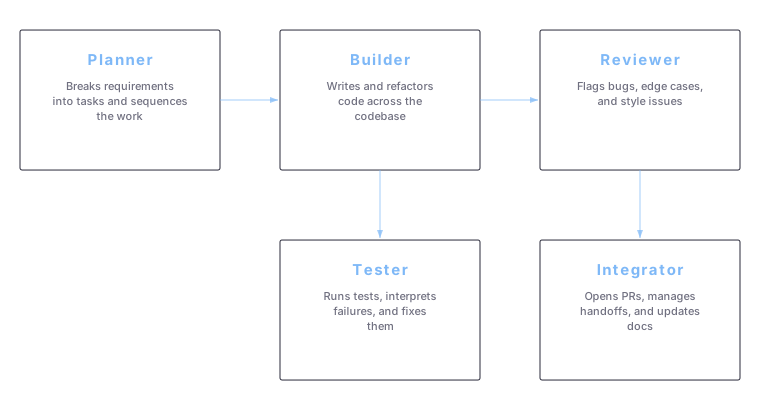
These agents don't just answer questions. They take actions — reading and writing files, running terminal commands, browsing documentation, calling external APIs. They work on the actual codebase, not a simulation of it.
Note: This isn't about replacing engineers. The ideal agentic team blends a human with sharp product judgment and AI agents that excel at rapid, consistent execution. One sets the direction. The others build toward it — fast.
The human isn't removed from this picture. The human sets direction, makes judgment calls, and reviews the output at key gates. What changes is the ratio: instead of one person executing every task, one person is orchestrating many agents executing in parallel.
You write a one-paragraph brief: "Add a CSV export to the reporting page, matching our existing button styles, and make sure it handles empty states gracefully."
An agentic system picks that up, locates the relevant components, writes the feature, writes a test, runs it, fixes the one thing that broke, and opens a pull request — all before you've finished your coffee.
That's not science fiction. That's what well-configured agentic workflows look like today, for the right kinds of tasks.
The caveat: "for the right kinds of tasks" is doing real work in that sentence. Agentic systems are excellent at well-scoped, well-defined work. They still need humans for ambiguous decisions, architectural tradeoffs, and anything where the brief is "I'll know it when I see it."
The original insight here is subtle: the bottleneck shifts. You go from execution being the bottleneck to framing being the bottleneck. The team can build fast. What you have to get good at is writing briefs that are specific enough for agents to act on without being so prescriptive that you've done the work yourself.
That's a new skill. And it's worth developing early.
If you're building an early-stage product, the limiting factor has rarely been talent. It's been throughput — the number of things you can move forward simultaneously.
An agentic dev team doesn't sleep, doesn't context-switch, and doesn't have opinions about sprint planning. It can run a dozen parallel workstreams that would take a human team days to sequence and coordinate.
This changes the economics of early-stage development in a specific way: you can stay in exploration mode longer. Instead of committing to one approach because that's all the bandwidth you have, you can prototype three directions in parallel, see what holds up, and double down on the winner. That optionality is expensive with human teams and nearly free with agentic ones.
We're in an uncomfortable window right now. The tools exist. The results are real. But most organizations haven't reorganized around the new reality yet — they're still using agents as autocomplete, not as teammates.
The teams that figure out how to design and operate agentic systems in 2026 won't just ship faster. They'll develop institutional knowledge about orchestration, agent design, and human-AI collaboration that will be genuinely hard to replicate later. The advantage compounds.
It's not about using more AI. It's about building a new kind of team — one where humans and agents each do what they're actually good at.
That's what I'm documenting here, in public, as I build it.
agenticdevteam.ai — a senior developer at the center, specialized agents filling every role.
Next in the series: Why I'm building this as a solo founder

